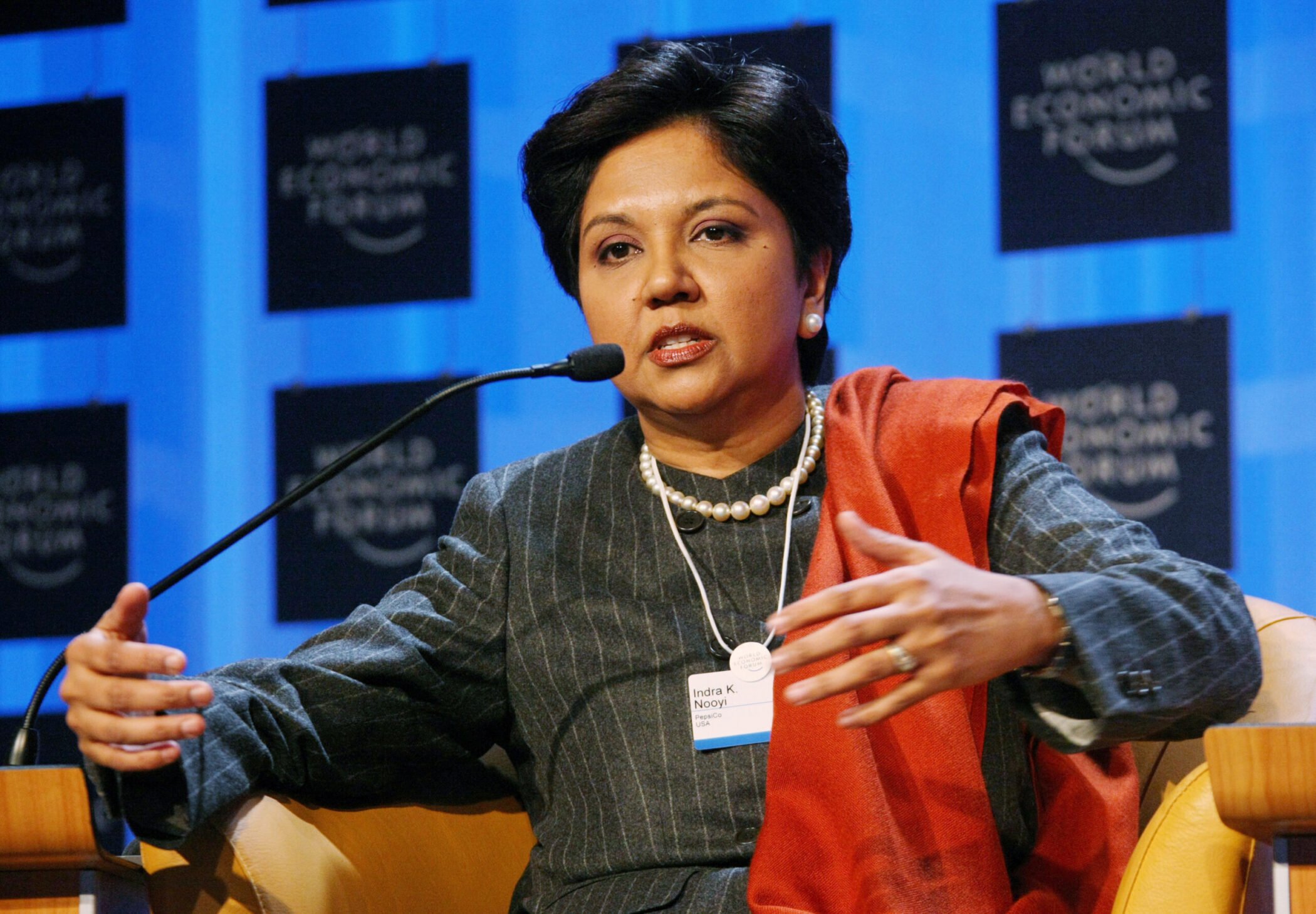
An immigrant could come in with nothing in her pocket and become the CEO of a
iconic American red, white and blue company. It can't happen in any other country in the world. I would never have
been CEO in any other country of the world including in India. So I'm genuinely grateful.
Attracting the very best talent from around the world, those seeking education and opportunity has been one
of America's greatest strengths for over two centuries. Immigrants have
contributed to our vibrant culture and our dynamic worldleading economy.
Indraui [music] is a part of that American story. Choosing to move to this country as a young adult, Indra embraced
America's openness and thrived within our worldleading institutions.
She became a trailblazing business leader. intro rose to lead PepsiCo, an iconic
American brand recognized around the world. Along the way, she developed a deeply personal understanding of what
makes American [music] freedom and opportunity so unique in this world.
for only in America. My [music] conversation with Indra Nui
Great to see you. Good to see you, too. After a long time. A long time. Right. Great to see you. Good. I'm well, thank you. You've
been fabulous as always. I was like then yes you should tell me right
so what's the [music] most interesting thing you're doing right now from your point of view uh being on the board of Amazon is
minding it must be yeah they keep seeming to re to invent new
business models all the time and uh the way people think and the way that people act so fast
I've never seen something like that [music] yeah so it's been quite amazing to watch when did you come to New York last I
don't get to these costs [music] that much. Probably four times a year. York has this feeling and the [music]
vibe vibe of energy that is unmatched anywhere and you know you stand on a street I
lived in Chicago for 10 years. You stand on the street called [music] in New York anywhere and look the fashions
people dress in the most interesting way. I go to Chicago sometimes the result is you hate to say I love Chicago
was born city but it's New York is just exciting. People dressing, they mix and
match things. They're like, "How did you think about this?" Yeah, it's a really exciting place. All right. Which of us is where?
We'll have you sit on this side. Okay. And I'm here and you have my phone with the I'm Stephanie's. All right. Anytime.
It's really pretty [music] suit. That's a skirt. Acris. Yeah.
That I'm matching. Chanel came home and taught me how to match my Chanel jackets,
other things other than Chanel. Oh, yeah. Right. Yeah. I used to match [music] them all. She said, "Don't wear it with jeans." Yeah, that's beautiful.
So, I'm wearing learning to wear it with jeans. Color is spectacular.
All right. Mark. Hey, Mark.
I'm here with my longtime colleague and good friend, uh, Intranui. We're here in
New York City looking out at this exceptional city, uh, that in many ways
has been a landing point throughout our history for people from all over the world. and we're going to have this
discussion about uh only in America. I really look forward to spending some time with you. It's been a while. Uh you
are of course the former CEO of PepsiCo, but very active still in the business
community and philanthropy. So we'll get to some of that, but I want to start with the with the following question. So
when my students come to me, they very often say, I want to be a leader. And I
say that's not a job description or a destination. And it does lead to the
question though of how one becomes a leader. There's this long question long
lifelong question are leaders made or are they born? So tell us about your
leadership journey. You know this question about are leaders born leaders or are they made into
leaders? Sort of a long-term question which has never been resolved. But from observation, I will tell you there's a
little bit of born leaders and then there's a lot of made leaders. Leadership requires you to have people
wanting to follow you, wanting to follow you with passion, wanting to follow you until you fall off the edge of the
earth. If you can evoke that kind of passion in people, then you're a real leader. It doesn't matter whether you're
charismatic or whatever. Your message, the way you approach whatever you're doing. The way you motivate people makes
people want to follow you. Now, to get to that point, you it's a lifelong
process. You have to watch, experience, practice, be put in situations where you
have to follow leaders and then you have to have people follow you. It's literally like practicing for the Olympics or some sort of a sport.
leaders are uh made through a very tough process if you want to call it that over many many years and so if somebody comes
to you and says they want to be a leader just tell them great I'm glad you have that aspiration watch leaders follow
them you know look at the mistakes they make and how they recover from it look at how they shape agendas and make
people follow them wherever they go look at all their habits and then learn from that and you know see how you can become
a leader too go for it yeah and also mentors, right? People who along the way help you to become a
better leader. Are there people along the way that you think back and you think, "Oh, how fortunate that uh that
person came into my life at the time that they did." I am a product of great mentoring right through my life. From the time I was a
kid growing up in India to the time I came to the United States, my belief is mentors pick you. You can't go to people
and say, "Can you be my mentor?" What can they do? Uh, I've been lucky in that
mentors I never expected would pick me to be a mentee, picked me. I didn't even know they were mentoring me. They pushed
me. They pulled me. They kicked me when I was doing things the wrong way. But they put me into difficult assignments
because they felt that if I could demonstrate mastery in that assignment, I could be pulled forward. In
retrospect, I realized they were all the best mentors. At that time, I was like, why is he pushing me so much? Doesn't he
like me now? Now I want to say thank you to every one of them and I do that but I'm a product of great mentoring and I'm
forever grateful to every one of those people who gave me so much of their time and energy and more importantly condi
good mentors are never insecure because they know that if they mentor you well
you could take their job. So I was the product of great mentoring and I took their jobs and so you know I consider
myself incredibly lucky that these people picked me. I always say that mentors are people who
see something in you that you might not even see in yourself. Exactly right. Exactly right. Because I would never have thought that
I was going to end up where I did when I was a young kid in segregated Birmingham, Alabama. This was very far
from anything that was imaginable. And I can't have imagined a little girl growing up in India. How did you make
the decisions that led you to this place? Especially the decision to come to the United States. That that must
have been in some ways a little bit wrenching. But you you've got to remember I grew up in India in the 60s
and the 70s. You know, that's when I was in India. India was a new country and women were not even a major force in
India at that time. Um most women stayed home and kept home. And in that India,
my father and my grandfather were now encouraging us as girls to go out and conquer the world and dream big and you
know to have men in the family say you don't have to be held back because of your gender. We're going to give you
wings to fly and we're going to remove all the barriers in your way so that society doesn't stop you from dreaming.
So I was lucky enough to be born into such a family. And then as the years went on, all my friends who came to the
United States would call me or write me and say the United States is a seat of
innovation, cultural advancement, uh incredible can do attitudes. Uh this is the place
you want to be, the kind of person you are, you will thrive here. So I went to my parents and said, "I'd like to go to
the United States." They said, "Dream, dream on. It's nice to dream about the United States, but we're going to get
you married. You're my mother. We're going to get you married. That's your job. So, surreptiously, I applied to the Yale School of Management, which had
just opened its doors, and it was a new school that was blending the public and private sector, and sounded fascinating.
I applied to it, and I got in, but no money. So, I went to my parents and said, I got
into the Yale School of Management. They said, "Yeah, dream on. Put that letter away because we can't afford to send you to the Y School of Management." Two
weeks later, I got another letter from Yale saying, "Uh, we're going to give you loans and a work study program to
study at Yale and fund yourself. Would you like to come?" And I went back to my parents and said, "All that you have to
do is to buy me a ticket, air ticket, and I'll repay you in spades later on."
Uh, and I don't know why they agreed. Till today, I considered that a character flaw on them that they allowed
me to sail the seas and go away from them. But they came to the airport, saw me off. I came to Yale and everything
that my friends told me about the United States was understated. This was the
most glorious country was and is. It was a seat of innovation. It was a seat of
um creativity, culture, a seat of uh people wanting to change the world
and uh I found it to be the most exciting place in the world. And one thing led to another and before I knew
it I was progressing up a corporate ladder. Yeah, that's really is it was word of mouth at some level with friends who
somehow knew something about the United States, knew it was a place that was different and uh you say it exceeded
expectations about how different it was. But when you when you arrived you must have thought uh what have I what have I
done? Well, it was a lonely place. Uh you know because there are not enough sounds on
the roads here. India is full of sounds, lots of people, lots of colors. Here it was a quiet place. So I landed in JFK
and went up to New Haven and uh for a moment I wondered whether I'd done the right thing. How am I going to cope with
this loneliness? Uh and then even at Yale it was a time when there weren't many international
students especially colored international students or colored students overall in the school of
management. And so I don't think I fit in. On the other hand, I will tell you
in our colored students banded together. We worked our tail off because to us we
didn't come there for the social life. We came there to study and to work hard and to move ahead. So the goal we had
was very very clear. Study, work hard, get great grades and somehow land a job.
Okay, that's all the objective was at that time. And so the fact that we didn't get invited to any parties or any
trips to the Cape or anything like that, who cared? We didn't know anything about it. We didn't dress well. We didn't do
anything the right way. And in those days, there weren't any counselors to tell you how to dress or how to talk or
how to interact with people, nothing. So, we were the misfits. And if I look back at
pictures of those days, oh my god, we were the misfits. But somehow we were viewed as academically pretty damn good.
Mhm. So by the time the second year rolled along, people wanted to be in study groups with us. People wanted to be in
projects with us. So we went from, oh my god, what has Yale done to not bad these
people are pretty damn good. So if we are in the group with them, maybe our grades will improve too.
And so we were desired and wanted and pretty soon we got integrated. And then when we got consulting jobs or
investment banking jobs, people looked at us and said, "Hey, these are brainiacs." Whether we were or not,
different issue, but respect just went up. Yeah. Purely because of the hard work and u
all the efforts we put in because we also had to work remember to make ends meet.
So we'd go to school in the morning, work through the night and I was a receptionist in my dorm from midnight to
5:00 a.m. So people realized that this was a gruelling experience for us and they've
respected us for that. Now, it must then have uh affected how you looked at
people like you as they were coming up as a as a leader. Now, you've made it,
so to speak. You've done your uh degree, you your consulting job, and
and you see young people who are maybe misfits, uh people who work hard but, uh
don't quite fit. Did it did it have an effect on your leadership uh style on
the way that you thought about these people? Both the immigrant experience and what came from that immigrant
experience which was not quite fitting in and having to prove yourself. It's interesting you've got to look at
periods because I came to the United States in 1978. By the time the 80s
rolled along, uh I'd say the immigrants were still misfits. I'm not not talking about European students who came here.
I'm talking about students who came from developing and developed countries. They were still misfits. By about the '9s,
Gandhi, they started to see videos of what was happening
in life in the United States and people would emulate those habits and clothes and the way of dressing and the world
was becoming more free in terms of exports and imports. When I was in India, it was a very restricted country
in many ways and there weren't too many imports and you didn't see much. But in the '9s everything changed. All of a
sudden you had many more students coming here. They were more used to a global environment and they were more seasoned
and swave. Everything that I lacked. I had you know I had courage. I mean I could debate. I
could hold my own but I didn't feel good about how I looked or appeared. The kids who came in the 90s all of a
sudden had uh you know courage. They stood tall. uh they knew what their
place was in society and they weren't as uh feeling so insecure as I did when I
first came here. So I think as the years went by things got better for them. Yeah.
So immigrants in general um they are people who've left something behind when
they come to the United States. They have certain expectations. I remember back in the old days people would say
that they thought the streets might be paved with gold but maybe it wasn't paved with gold. But it was paved with
uh the possibility of ambition, right? The possibility of starting a new and uh so there was that spirit and do you
think we still have that spirit among immigrants? Are we doing the right things to make sure that people still
feel that way about uh the possibilities that the United States will bring?
So there used to be uh an observation many years ago which said if you opened
the doors of every country wide open where would people go?
And the answer was the most number of people who leave their countries would
still want to come to the United States because it was the greatest country. I'm going to say boldly that even today if
you did that most people want to come here because in spite of some of the flaws we might have we are still the
greatest country in the world and people will still want to come here because what made the United States so attractive for me when I came here in
1978 still holds today somehow when you come here you change you become more
exciting more aggressive more uh transformational more innovative I don't know what it is about the environment
here. Look at New York. You drive around New York, you want to become a different person.
You watch fashion in New York on street corners, you want to go and dress fashionably. I mean, everything about
what you see here sort of excites you country. I hate to say this is the place to be.
The United States and New York are just exciting. And so I think to immigrants
especially immigrants who want to come here for a degree. Uh this is unbeatable
versus any other country in the world. And I'll say that without any hesitation. There is something about this place and
I often uh am a little bit concerned that people who were born here and perhaps don't see it coming a new
don't quite understand it. So you've begun to describe it. So, if you were to say to an American citizen, somebody
born here in the United States, here's how you should feel if you were
an immigrant. Here's why as an American citizen, you're really lucky. What would you say?
I say this to my daughters all the time. I say to them, you have no idea how lucky you are to be born in the greatest
country in the world. And they look at me and say, tell us how it's the greatest. And I tell them, you know, let me tell you what life is like when you
go to any other country versus what it's like here. U let me think, let me I'll start with technology. All the big
technological innovations, they may have happened in other parts of the world, but they were commercialized here.
Technology developed doesn't make any difference. It's when you commercialize it and make a difference in the world is
where it really where the rubber hits the road. So I give them examples of commercialization happens here. This is
where an immigrant could come in with nothing in her pocket and become the CEO of a iconic American red, white and blue
company. It can't happen in any other country in the world. I would never have been CEO in any other country of the
world including in India. So I look at them and I say look at what I could achieve here. It's because the system is
a meritocratic system. Mentors don't care whether you're male, female,
ethnicity, gender. They don't care. They just want the best brains to rise to the top. So you guys should be happy that
you're in this country and you've got to do everything possible to maintain the spirit of this country because
ultimately the future generations instead of criticizing what's not working, go fix it and keep this country
great because there isn't another one like this anywhere in the world. And I say that with all sincerity because I'm
genuinely grateful to the United States because I came as a guest and the US
welcomed me with open arms. So I'm genuinely grateful. Let's talk about uh that career which is
an extraordinary career and um how you moved through from uh the
the receptionist at the Yale desk uh up through to become uh the CEO of uh
PepsiCo. What what were some of the moments along the way that shaped you
and then shaped how you thought about leadership and perhaps also about innovation? I think people don't realize
the degree to which a consumer brand like PepsiCo also has to innovate constantly.
Uh take us through some of your journey in that way. Um I think my there are many u contri
contributors and contributions to my journey. Okay. U there's what I did and
how that contributed. My mentors, oh my god, without them I'd
be nobody. And then the institutions I was a part of. I think all these played
a part in my life. Let me start with my mentors. My mentors believed in me even
more than I believed in myself. [snorts] They would give me impossible assignments to do just to prove to the
world that I was worth mentoring. Um they would lift me up at points when I thought I could never be lifted up. Um
and I must say all my mentors were white men. Yeah. And I'm grateful to them and many
of them were you know part of the armed services in the United States before they came to PepsiCo or any other place.
And um they were just unbelievable mentors. They would tell me no believe in yourself. You know you're capable of
doing this. Let me give you a little push and you'll do way better than you're doing now. So in so many ways
they shaped me. That's one contribution. I worked awfully hard. only as I think
back of my to my life I worked so hard I was never happy with my output I always
thought I could do a little better and a little better and a little better maybe that's not right because when you go for
perfection you give up everything else to set your own definition of perfection and for me that definition was never
ever with an end point so I kept saying I could make this better just a little better why don't I think about this so I
pushed myself so It got to a point where my bosses would say, Indra, if you've
looked at it, we don't even want to see it because we know how hard you work at these things. It must be perfect. So, I
was a hard hardworking person. But then I also was in the right institutions because it's not enough to just have a
mentor and work hard. Whether it was the Boston Consulting Group and I graduated to Motorola another iconic American
company to Assia Brown Bavi which was big in a European company big in power
and industrial uh equipment. I learned a lot about different industries and then my luck I joined PepsiCo great consumer
brands. Um I went from industrial and electronics to consumer and um some
people look and say what the hell are you doing in a consumer company you know with BCG and the training you get in
consulting you can go into any industry as long as you understand the value drivers you can go in and make a
difference right away which is what I did in PepsiCo I never went in saying I want to be CEO
I said I'm going to nail this job so so my bosses would say this is how the work
should be done that's all I wanted to And when they promoted me, I'd always say, "Do do you really want me to be
promoted now? I'm happy doing what I'm doing." And I became CFO. I'm like, "Do I really want to be CFO? I'm happy
being head of strategy." And Roger Enrio was a CEO at that time. Just just get your ass into that office
and start your CFO on Monday. So, if you start saying, "I want to be a CEO in 10 years," you get obsessed with that
as opposed to do the job you're doing very, very well and everything else will
take care of itself. And it sounds as if you love to work. I actually enjoy it. Yeah, that brain uh
being uh challenged to do the impossible. I loved it. Love learning new industries, new businesses,
zooming out, zooming in. I love that. But there are challenges in any job of
that kind when you're and talk about some of those because you were in a very competitive business. I mean the the
challenges before uh consumer businesses in the United States again in the United States Americans have all kinds of
choices. This is another thing that is very American. I remember too many choices. Too many choices. I I remember bringing
a group of Russian immigrants. I helped Russian immigrants relocate in Colorado as a grad in graduate school. It was one
of my jobs because I spoke Russian. And um I took some of them one day to the grocery store and they said, "Well,
which one's coffee?" I said, "Well, they're they're all coffee." And they said, "No, but which one is coffee?"
So, one of the problems if you're running a consumer brand is there are a lot of choices and you have to win
uh the audience, you have to win the customer and that can be challenging. So how did you think about the relationship
between what you were doing in the company and this great vast country of
uh consumers and and how one uh attracts them to what you do? Well, I was blessed in that I inherited
a portfolio of fabulous brands which had been built and invested over decades. So
I was not functioning with one hand tied to my back. So I had this great portfolio of brands. But there's a
problem because none of them were were in trouble. So I I inherited a successful company and to me keeping a
successful company successful is more difficult than turning around an unsuccessful company. So I had the
successful company and I sat back and I said do I just keep running it the way
it was run? You know I was president before I became CEO or do I have to pivot in some way because the world is
changing. And so the first thing I had to do is figure out how is the world changing or going to change over the
next 10 or 15 years and do I have to pivot and by job I discovered that as
you look at the edges of our marketplace lots of changes were happening and we
were focusing very narrowly on a core and sort of ignoring the edges which were nibbling away at our core and
that's what led to us thinking more future back. How do we change our products? How do we shift the products
to a healthier offering? How do we make our business more environmentally
palatable? And how do we create an environment in the company where people want to come to work for PepsiCo as
opposed to go to work in Silicon Valley or Wall Street or consulting? And so there were lots of things we needed to
change about the company. Now, this goes back to the earlier question you asked me. You see, because I was the first
colored woman to run a Fortune50 company, there was way too much focus on me.
Yeah. Uh and anything I did right, they didn't really talk about it. But anything I may
not have done right, they played it up like, "Oh my god, remember she should never have been CEO of this company
because she's not that capable." So it would be that undertone that would show up in articles. It was very difficult to
be in the public eye and to affect a transformation. This again goes back to mentors. In this case, it was the board
of directors. They basically said, "We agree with the strategy. This is the only way to run the company. We have
your back. You just keep doing what needs to get done." And that required transforming our R&D, transforming our
product portfolio, buying new brands. It was constant learning, constant innovating, figuring out how to extract
growth when the market was only growing 2 to 3%. How to get another point or two
of growth. constantly. What I discovered through this process was growth is oxygen
and innovation drives growth and so you had to create that spirit of
growth inside the company. So innovation was everything we did innovating products, processes, platforms, uh
people, practices, innovating on every aspect that we could in order to create a new company for the future as opposed
to running an older company just, you know, screwing it tighter. said, "No, let's remake this company for the
future." And that's what we did. I often wonder too if uh the willingness to take risks uh even in a company where
uh you have great brands and it's an iconic company, uh you you took some risk to come here
as a young person from India and to get yourself into uh Yel's management
school. Do you think that risk-taking uh that ability that willingness to uh to
not stay where you are but to keep moving forward uh it seems to be sometimes a very it's not just an
American thing but you see it a lot in America and it maybe was one of the things that attracted you to the United States that word of mouth
that your friends were giving you about what meant here did you ever have to draw on that as you were moving through
interesting more than the risk it's the immigrant fear we all have an immigrant
fear as a first generation immigrant that you might fail and you'll bring so many people shame because you failed. In
my case, I didn't want to let women down, women of color down, immigrants down, Indians down, my family down. I
mean, everybody was looking at me saying, I hope she succeeds. So, in my case, I was taking huge risks, but I
also knew there was a lot on my shoulder. Mhm. And so I had that immigrant fear in me that propelled me to do better and
better all the time. You know, interestingly, Connie, that immigrant fear has not gone away even today. I
still have it which says I've got to make sure that I do the right thing. Um I am a guest in the United States.
They invited me in. I've got to live by the ideals of the country. I've got to prove to the country that they made the
right bet on me. That's just me. I can't change that. I feel that way. In many ways that was a positive propellant
rather than a negative detractor for me. So I feel I feel relieved that I had
that driver in me all the time. Yeah. And so I took calculated risks knowing
that I might lose my job sometimes. Uh but then we never lived high. We lived
simply and even if I had lost my job we we could have lived on one salary. Not an issue. So we both were very
comfortable that the risks I was taking were calculated and it was worth
fighting for and that's what we did through our career. You know it's the 250th anniversary of
the United States and uh people mistakenly say that's when our democracy was born. Well, actually that was our
revolution because but the the constitution, the institution that would be born later to
protect those rights and to protect that uh that ability and that willingness to take
risks. Um do you ever reflect on that part of America? Not just the kind of spirit and
culture, but the institutions themselves, the way that we govern ourselves. And do you talk to your did
you did you talk to your kids about it? Well, I've been reading books written on past presidents. Uh, you know, David
McCulla wrote some great books. Great books. Um, I've read those and I've read a lot about how people came over from Europe
and then how they crossed the country and they took massive risks. They gave their life.
Uh, they u built the infrastructure that we know today. A lot of them built the infrastructure that we know today.
And I think waves of immigrants are coming now and building new infrastructure. It was a physical infrastructure then. Then it's a
software infrastructure. Now it's a new kind of AI infrastructure for all of these different groups of immigrants are
now helping lay the tracks for the new United States. But through it all,
through all of these changes that happened in the country over time, I I read about the leadership. I mean,
when I read John Adams, the book about John Adams and they were trying experiments in the country which had
never been tried before, writing the bill of rights, writing a constitution. All of these are risky things to do
really because you're asking a country to live by a code and a framework which the country never had before and for all
the supporters you had detractors too. But those leaders had the courage
to do this for the sake of the country. And to me these founding fathers and the
founding leaders um had a sense of country that you don't see in too many
countries. I wish many more countries had that deep sense of country that the founding framers had in this notion of
the United States of America. Yeah, they were pretty remarkable. They really were. And and you grew up of
course in a place uh which is a democracy um a place that uh has had as a result
of that uh its trials and its tribulations, but also uh an interesting
relationship with the United States itself. And um I spent a lot of time on US Indian relations. I remember when
President Bush said at one point um India is uh the largest democracy in the
United States is the oldest democracy and therefore uh we should in some ways uh find ourselves uh natural partners.
He said do you see that as uh someone who was born in one country born in India and
has lived your life uh in another. Do you see those connections between the
two? I don't know any other model but democracy. Yeah. Okay. I didn't live in any oppressive
regime. I grew up in a young India that was just liberated from colonial rule.
350 years of colonial rule because I was born seven or eight years after independence. So I was born into free
India a democratic India. Uh and that's the only government model that I know
model of governance that I know which is great. I think that um the US and India
are natural partners should be natural partners because India being the largest
democracy today population is the largest with an incredible demographic dri dividend where 50% of the population
is less than 35 years old and the largest English-speaking population
because you know when you have 1.4 4 billion people uh even if 20% of them
speak English that's a large population and the numbers more than 20%. And so uh
it's a country that is going to be pivotal for the future of the world whether it's uh engineering graduates
that come out software people people working in AI uh Indian Indians and
Indian diaspora are going to be contributing quite a lot. I think um all
countries go through ups and downs in their relationships over time and it has to be reset every now and then. I just
hope that whoever's the in the leadership position in the United States walks a mile in the shoes of the leader
of India and I do hope the leader of India always walks a mile in the shoes of the leader
of the United States because each one has to look at each other's country through that lens and u before any
action is taken either way out of pride or out of uh economic necessity you just
have to understand the other's point of view as opposed to immediately getting hurt both sides. So I think it's a very
very important relationship for both countries and I hope it stays that way and um I think to the extent that we
remain in a geopolitical competition or race versus China I think
India becomes a very pivotal country because you don't want that part of the world being taken over by China which
you know is a logical partner. Uh I think given the bad neighborhood that India is in, it's critically important
the United States protects India and allows democracy to thrive. Thrive. Yes. Because India and America
are democracies. Um and u you've never had to live in a country that was not
democratic. I didn't have to live in a country that was not democratic. Uh it it is a place where you can try to be
yourself. And uh one of the elements of it and something I think that will ultimately
be hard for China is competition uh almost in every aspect whether it's
in sports or in the arts or competition's a part of who we are and
it is part awfully important of course in the business world. How do you think about yourself in that regard? Are are
you a competitive person? I have a feeling you are. [laughter] You know positively competitive. I'm not
competitive but I want to kill others. I want to be competitive to move ahead and move my agenda forward. Let's talk a
little bit about China and India because I think you know in that Asian context very important if you go to China the
competition is pretty aggressive inside China. Even in beverages the number of
Chinese brands that used to be on the shelf was fantastic. And so anybody who thinks there isn't competition in China
is mistaken. There isn't hyper competition like you have in the United States. The US is the most hyperco
competitive environment and that's what makes it so exciting. You could die faster if you didn't, you know, stay,
you know, nimble and vigilant. Uh but in China, it's still very very competitive
and companies look to kill each other uh through technology, through the next offering and that's why you see faster
cycles of innovation in China. So China is actually uh for a centrally planned
country a very exciting competitiveish market.
Yeah. Competitive and and these days adversarial which is a problem for
in a way they're going to keep us on our toes. Yes. Maybe they'll keep us on our toes. That's a that's a great way to think
about it because they are very competitive. But I want to go back to the the India experience because um we
and India and China we have lots and lots of students who wanted to study in China at Stanford um and who wanted to
learn math. Chinese students Chinese students coming to the United States and American students going to China. Not as many
because language is hard for Americans. But we did have lots and lots of students studying Mandarin. We've had
far fewer students who have been who've wanted to go to India who've gone to
India and I've always thought that that was a missed opportunity because uh in because India is such a dynamic and
interesting society. You made a very uh good point uh not one language, not one
religion. It's actually an extremely diverse society. Um how how would you tell American students you really ought
to spend some time in India? I think the interesting thing about China is that it's relatively homogeneous.
Okay, there might be different versions of Chinese but it's a relatively homogeneous country.
Uh as a visitor going there and spending some time, it's easier to do that in China than it is in India. India is a
chaotic country. The beauty of India, India lies in its chaos. Absolute chaos. Um, and if you are familiar with India,
you've traveled in India before and you like that chaos all around you, you go back. It's like a drug. You get addicted
to it. But if you like order, if you like uh, you know, clean living, India
is going to be impossible to take. When you see cows on the road along with the
cars, you go, "What the hell is going on here?" [laughter] Hey, we know how to dodge the cars and keep going. Okay,
that's life in India. I think Indians have a uh hey you know this too shall
pass you know maybe India will develop some more but all of these cows on the road are part of life we just take it
for granted um we're very spoiled in the United States that's another thing I tell my kids look at our environment
look at the orderliness that exists here in spite of people critiquing ourselves
don't we have it so good here our stores are open 24/7 no other country in the
world Is it open 24/7? Our malls are open 7 days a week. You go to Europe,
they shut down half the time. So I sit here going, you have no idea how well you have it here. So just enjoy those
freedoms. But China versus India, I respect the Chinese system for what it
did to pull China out of, you know, the dark ages. And they've become a world
power because they did it centrally. India is still struggling to be a world
power because democracy rules and uh when everybody has a vote and
everybody has a say, progress is slow. But I'm glad it is that way. I'm glad it's a democracy because the
one thing that an authoritarian regime does not have is it has no peaceful means to transfer power.
True. And that has been for autocrats um a fatal flaw many many times in
history. Whereas democracies as messy as they are and they are messy and cacinist even American democracy is caffinous. Uh
we we know that at some point we can say we don't want them we want someone else.
Somebody told me a very interesting observation. They said um if you go to any town in the United States there's
always a courthouse. Yeah, that's right. Okay. You go to any town in India, you know, decentsized town, there's always a
courthouse. There are no courouses in China because the government is your
rule maker and your decider. And so that's where it becomes problematic. And
that separation, the fact that we have a judiciary that's so visible is what gives people comfort that they have a
right in the country and and as we've seen um a willingness to use it. Oh, totally is. Absolutely.
Absolutely. But there's another side of America that I'd like to spend just a couple of minutes on and and that's
something that you particularly since uh you stepped down as CEO of PepsiCo. You've been very involved in what we
would call uh civil society uh the arts. Uh you're on the board of uh Memorial
Sloan Kettering. When Dtokville came to the United States in 1835 to to
understand what these Americans were like, he said uh he said that one of the things was
was puzzling were these voluntary associations where Americans got together just to do do good and uh we
have a lot of them and people give of their time uh as you do. Uh how do you think about that part
of who we are? the the philanthropic side, uh the the willingness to to uh
give a hand up to those who don't quite have enough. How how do you think about that? My observation from all the towns I've
lived in, and I've lived in Illinois, and I've lived here in the East Coast, there's an incredible sense of town,
community, your neighborhood, your state, and then the country. There's an
incredible pride and ownership. Um, the way people band together to solve a
local issue is unbelievable. The way they put their hands up to address uh uh
uh you know the town library going down and how to fix it or the park is in disrepair. How do we band together to go
fix it? You don't have to force people to do it. They just do it because they say this is our community. This is our
town. Why did we let it get there in the first place? uh anytime there's a crisis people just band together to go and work
on these issues. So to me the sense of you know neighborhood, town, community,
state, country is unique uh in in in the United States. It might
happen in parts of Europe too. I don't know. I haven't lived there as such to see this happening. But it's an uh it's
manifested itself in spades in every walk of life that I've been part of. I mean I speak for myself. I retired as
CEO and I actually felt that I owed the country my time
because the country enriched me when I was CEO and I've given back in every possible
way. I was teaching up at West Point was the most fulfilling learning experience whether it's on the border memorial
Sloan Ketering the National Gallery of Art whatever it is if I'm called to do something I will do it because at the
end of the day I owe this country my gratitude and to me uh it's infectious I watch
other people do it only in America do I want to step up and say count me in I
want to contribute too it's a it's a beautiful part of being American, that sense of uh some
obligation to uh your your city, your state, your country, but also to your
fellow citizens. Absolutely. It really gets us through a lot sometime. So, if I were to uh ask the the young
Indranoi, what would you have expected in life?
And then to the more mature, I never say older. What would you say about the
wondrous journey that America allowed? In other words, what is your American
story? I tell you, um, a young Indranui, I would never have imagined reaching the
dizzying heights that I reached because it was beyond my, um, you know, vista. I
I never had that kind of vision. I don't I didn't know what the United States was. To me, coming to the United States
and evolving and growing in my journey was like being a kid in a candy store.
Every experience was like, "Wow, is this what I'm going through?" So, while I was
doing that, I had to have one foot firmly planted to say, "Let me not get carried away by all of this."
And that's where my family played a major role. uh with my mother always
saying, "I don't care if you're a big shot, leave your crown in the garage because you don't need to bring your
crown into the house. You're the mother, you're the wife, you're the daughter, the daughter-in-law. Don't forget this those roles." Okay, mom, I remember
that. Don't forget it. She'll she'll remind me all the time about it. So, that anchored me. Um I also never forgot
my immigrant roots in the sense of I'd always reflect back on how I came with so little and the journey. I think back
on that journey a lot and um I um think back of the difficult
times and the good times. The difficult times and who pulled me out of it and the good times and who lorded me for it
and kept me going. So all of that together in my new form as being the
more mature Indranoi, the older Indranoi, I can say that the older Indranui um I look back with the sense
of gratitude but I just hope people look at my journey and say that's a life well-lived but also life amply
contributed in every aspect of my life. I hope that's the message they take away rather
than oh she became CEO. No, I became CEO. I earned my way into being CEO. And
along the way, I mentored people. I push pulled people up. I pushed people. Uh I
contributed to society. I contributed to my community. Anybody who called upon me, I contributed.
And so I hope people look at that and say uh it was a life well-lived, but it
was a life amply contributed to also. Yeah. Well, Intanoi, you are an American
story and uh your story of um why uh America is the place that so many of us
have a story that probably could only have happened in America. Thank you for spending the time with us and with the
Hoover Institution to to think about that. I think of that great song which said only in America they can dream in red,
white and blue and have the freedoms. I believe in that.


