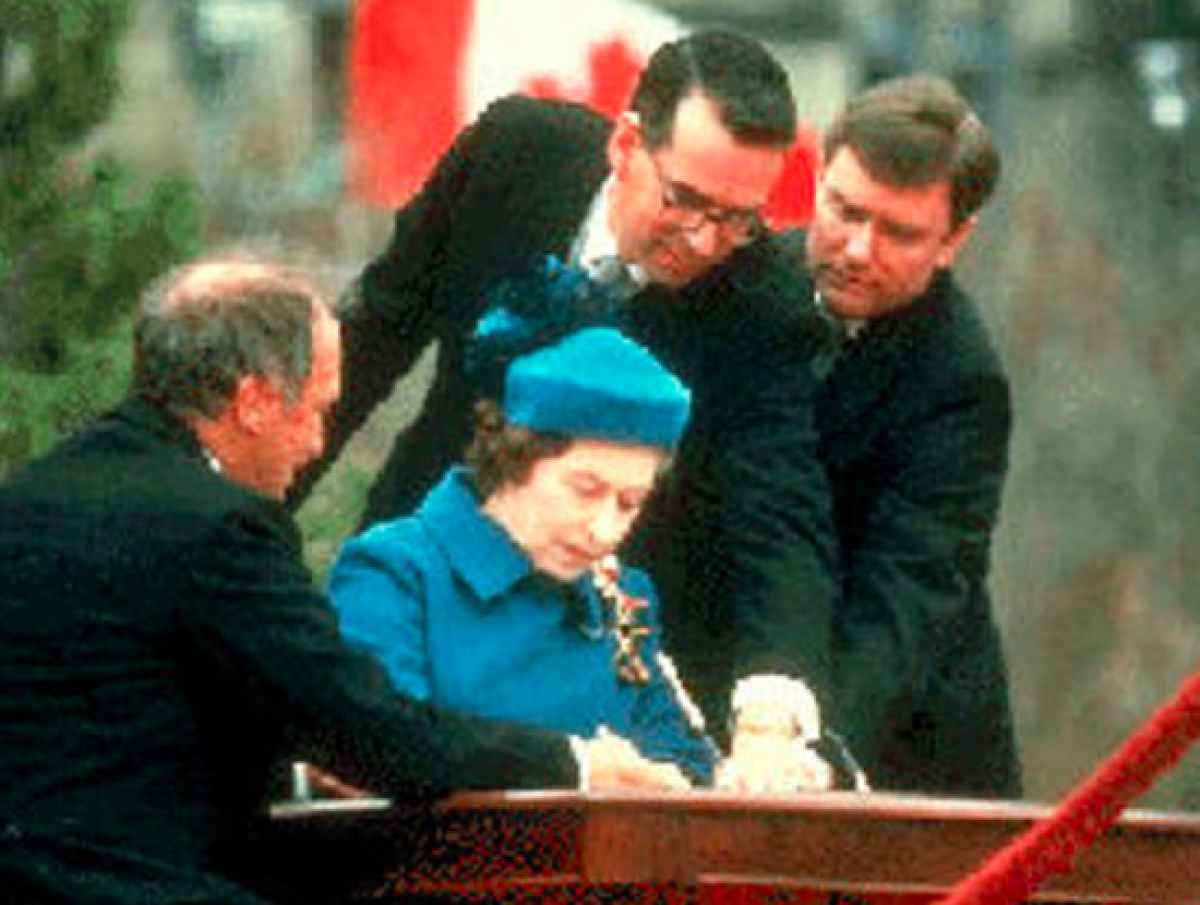
1982年加拿大独立日,伊丽莎白女王签署宪法法案
社论:加拿大宪法回归故土
作者:诺曼·希尔默 2013年4月16日
https://thecanadianencyclopedia.ca/en/article/patriation-the-constitution-comes-home-feature
以下文章为《加拿大百科全书》编辑部撰写的社论。社论通常不进行更新。
1982年4月,渥太华的冬去春来之际,伊丽莎白二世女王第十一次访问加拿大。她此行的目的是正式宣布:经过半个多世纪的努力,加拿大终于拥有了自己的宪法。制定一部加拿大宪法是该国殖民历史遗留的未竟之业。1867年的《英属北美法案》规定了联邦政府和省政府的管辖范围,并创建了加拿大自治领。然而,该法案是英国议会的法律,只能由英国进行修改。
自第一次世界大战和第二次世界大战之间,加拿大摆脱大英帝国的束缚以来,加拿大政府就一直在努力“收回”《英属北美法案》(即收回其控制权)。 (另见:帝国主义;英联邦。)总理皮埃尔·特鲁多坚持认为,每次加拿大想要修改宪法都要“卑躬屈膝地去拜见外国政府”,这是不可接受的。
1982年宪法的庆祝活动原定在国会大厦闷热的参议院议事厅举行。但在不到两周前,活动地点被移至国会山,利用了记者约翰·格雷所称的“世界上最大的电视演播室”。4月17日星期六上午11点37分,伴随着嘹亮的号角声,皮埃尔·特鲁多邀请身着绿松石色长袍的女王离开临时宝座,在宪法皇家公告上题写“伊丽莎白二世”。这份公告是用曼尼托巴亚麻纸以优雅的字体书写的。
宪法回归加拿大
1982年4月17日,伊丽莎白二世女王与总理皮埃尔·埃利奥特·特鲁多签署了回归加拿大的宪法。
(图片由罗伯特·库珀/加拿大图书馆和档案馆/PA-141503提供)
组织者预计将有10万名观众参加仪式,但由于天气恶劣,实际到场人数有所减少。就在女王准备向约3.2万名观众发表讲话时,突然下起了雨夹雪,雨伞被吹得高高飞起,贵宾们也纷纷逃离。女王讲话的大部分内容都听不清楚了。
对于加拿大英语媒体来说,这似乎无关紧要。这部宪法是一项胜利,它的签署是一个盛大而令人欣喜的时刻。《多伦多星报》高呼:“为加拿大欢呼!”
魁北克省省长勒内·莱韦克则以另一种方式纪念这一天:他在蒙特利尔领导了一场反对这部宪法的抗议游行。他坚称女王的到来是为了粉饰平庸。
特鲁多和莱韦克是这场持续18个月、最终导致4月17日事件的斗争的核心人物。联邦主义者特鲁多和分离主义者莱韦克是典型的对手:他们都是能言善辩、魅力四射的政治家,拥有坚定的信念、远大的抱负和忠实的追随者。
特鲁多赢得了1980年魁北克关于主权-联盟的公投。他承诺进行宪法改革,并誓言“我们绝不罢休,直到完成这项目标”。他立即提议将《英属北美法案》“归还”(这个词是他特意创造的)。他还承诺将制定修正公式(未来修改法案必须满足的标准)和一份阐明加拿大公民权利和自由的宪章。
1980年9月的一次省长会议上,特鲁多与莱韦克以及大多数省长针锋相对,最终会议以混乱告终。“我现在就告诉你们,”特鲁多回应道,“我们要单方面行动。”他威胁要让加拿大议会通过一项决议,要求英国在未经各省同意的情况下通过必要的立法。
为了确定此举是否合法,加拿大最高法院受理了此案。在1981年9月的“归还领土参考案”中,法院裁定特鲁多有权单方面采取行动,但这样做违背了历史和惯例——违反了宪法惯例。这一裁决是在宪法分歧双方强烈情绪的背景下作出的,它巧妙地平衡了可行性和合理性。
特鲁多决定最后一次尝试寻求共识。 1981年11月,各省省长齐聚渥太华,会面四天。莱韦克原本是反对特鲁多计划的“八人帮”成员之一。但特鲁多提出可以通过全民公投解决问题,从而孤立了莱韦克。尽管莱韦克对可能再次爆发决定国家命运的激烈政治斗争并不在意,但其他省长却惊恐万分。反特鲁多联盟就此瓦解。
莱韦克熟睡之际,他昔日的盟友们在厨房储藏室里与司法部长让·克雷蒂安达成妥协。(参见“厨房协议”)。第二天早餐时,莱韦克被告知这项协议已成既成事实。
他带着屈辱和怨恨离开了渥太华。围绕《厨房协议》发生的事件在魁北克分离主义圈子里被称为“长刀之夜”。
宪法被带回了家,而魁北克从此再也回不到从前。魁北克人感到深深的背叛。在接下来的二十年里,这道伤口难以愈合。与此同时,《权利与自由宪章》彻底改变了加拿大的法律体系。它极大地增强了法院在个人权利和社会价值观领域的权力。
独立日快乐!
https://www.historicalsocietyottawa.ca/publications/ottawa-stories/momentous-events-in-the-city-s-life/happy-independence-day
伊丽莎白女王签署宪法法案公告,1982年4月17日
1982年4月17日
历史上并没有一个明确的时刻标志着加拿大作为一个独立国家的诞生。相反,我们看到的是一系列日期,它们代表着从殖民统治到完全独立的宪政进程中的各个阶段。更复杂的是,加拿大实际上在法律文件签署的几十年前就已经独立了。令人困惑的是,这些日期都与7月1日的加拿大国庆日不重合。加拿大国庆日是为了纪念《英属北美法案》(BNA法案)的通过。该法案是英国的一项立法,于1867年的同一天生效,标志着加拿大自治领的诞生。该法案规定了宗教和语言权利,以及联邦政府和省政府各自的职责,并最终成为加拿大的宪法。但它并未改变加拿大在大英帝国中的地位。
尽管加拿大何时独立尚存争议,但有两个日期被认为是加拿大的“独立日”。第一个是1931年12月11日,即《威斯敏斯特法令》在伦敦获得御准之日。第二个是1982年4月17日,即伊丽莎白女王在渥太华签署1982年宪法法案之日。虽然前者有其合理之处,但我更倾向于后者。
1931年12月11日,《威斯敏斯特法令》正式生效。英国议会由此放弃了未经自治领政府同意而为其制定法律的权利,也放弃了根据1865年《殖民地有效性法案》推翻被视为“与英国法律相抵触”的自治领立法的权利。该法令是加拿大总理麦肯齐·金与包括南非总理J.B.M.赫尔佐格在内的其他自治领领导人在1926年帝国会议上共同努力的成果。与会领导人一致认为,大英帝国境内的英国及其自治领政府(加拿大、澳大利亚、南非联邦、新西兰、纽芬兰和爱尔兰自由邦)在内政外交方面互不隶属,尽管它们都效忠于英国王室,并且都是英联邦的自由联系成员。
在《威斯敏斯特法令》通过之前,加拿大的总督由英国政府任命(更准确地说,是由英国王室根据英国政府的建议任命),并向英国当局汇报工作。1931年12月11日之后,加拿大的总督由英国王室根据加拿大政府的建议任命。此外,加拿大和英国政府之间的外交接触由具有大使级的高级专员负责,而不是由总督直接与英国当局沟通。加拿大也可以在没有英国参与的情况下处理与其他国家之间的外交事务,尽管根据惯例,加拿大已经这样做了多年,早在1911年就与美国签署了双边协议。
然而,《威斯敏斯特法令》是否意味着加拿大独立尚存争议。1959年,谢布鲁克选区的进步保守党议员莫里斯·阿拉德对此深信不疑,他在下议院提交了一份私人议员法案,宣布12月11日为加拿大独立日。然而,和大多数私人议员提案一样,他的提议最终不了了之。
1931年,《威斯敏斯特法令》的通过几乎无人问津;并没有像独立日烟火那样引起轰动。《渥太华晚报》的简短报道夹在一篇关于一名美国女大学生被绑架的新闻和另一篇关于四只圣诞火鸡被遗弃在渥太华警察局的新闻之间。《多伦多环球报》在第十四版报道了该法令。该报称其为“一项令人钦佩的立法”,但同时指出:“但说实话,除了少数几个满脑子‘身份’的绅士之外,加拿大还有谁会关心《威斯敏斯特法令》呢?”在另一篇文章中,《环球报》写道:“就加拿大而言,一切实际上都和宪法细枝末节的争论开始之前一样。自1867年以来,加拿大一直独立治理,不受任何外部势力的干涉;她将继续这样做。”
《环球报》的说法部分正确。英国上一次推翻加拿大法律是在1873年,当时涉及一项关于宣誓的法案。虽然加拿大在内政方面实际上享有独立地位,但在外交方面仍然处于从属地位。因此,当英国在1914年8月对德宣战时,加拿大自动加入了英国一方。但《威斯敏斯特法令》通过后,情况发生了变化。英国的宣战
1939年9月对德宣战并不意味着加拿大也卷入了战争。为了强调加拿大的独立性,总理麦肯齐·金在加入盟军前等待了一周。虽然加拿大和英国的君主是同一位,但王位实际上已被分割。如今,既有英国王位,也有加拿大王位,而这两个王位都由同一人担任。王位可分割性随后成为英联邦普遍接受的宪法原则,女王在加拿大时听取加拿大总理的建议,在澳大利亚时听取澳大利亚总理的建议,以此类推。
尽管有《威斯敏斯特法令》,1931年后加拿大与英国的法律和宪法联系依然存在,这使得加拿大继续处于从属地位。伦敦枢密院司法委员会是加拿大民事案件的最高上诉法院,直至1949年。加拿大总督也继续由英国人担任,这一任期持续了二十年。首位被任命为该职位的加拿大人文森特·马西直到1952年才就职。最重要的是,该法令明确规定,对《英属北美法案》的修改不在其管辖范围之内。换言之,未经英国议会同意,加拿大人无权修改本国宪法。这并非英国政府坚持保留的权力。相反,这种不合常理的情况是由于联邦政府和省政府无法就宪法修正案的制定方案达成一致。因此,直到1982年初皮埃尔·特鲁多政府最终将《英属北美法案》归还加拿大之前,加拿大议会在某种虽有遗留但至关重要的方面仍然隶属于英国议会。
1982年3月29日,伊丽莎白女王以英国女王的身份签署了《1982年加拿大法案》。该法案是应加拿大政府的要求,由英国议会通过的,旨在将《英属北美法案》归还加拿大。三周后,即1982年4月17日,加拿大女王在渥太华签署了由加拿大议会通过的《1982年宪法法案》。该法案包含《加拿大权利与自由宪章》和宪法修正条款,构成了加拿大宪法的一部分。宪法的其他重要组成部分包括《英属北美法案》(在加拿大更名为《1867年宪法法案》)及其后续修正案。
将宪法纳入加拿大的决定极具争议。两年前,魁北克省就“主权联盟”举行的分离主义公投失败后,总理特鲁多曾承诺对魁北克省进行宪法改革。但尽管经过漫长的谈判,联邦政府和各省仍未能达成共识。一个主要的症结在于拟议的《权利与自由宪章》,许多省份担心该宪章会将权力从立法机构转移到法院。只有安大略省和新不伦瑞克省支持特鲁多。其他省份,即所谓的“八人帮”(包括魁北克省),坚持抵抗。1981年11月,在渥太华举行了最后的谈判后,特鲁多威胁要在没有省份支持的情况下将宪法移交加拿大——最高法院裁定此举合法但不可取——“八人帮”最终瓦解。在后来被称为“长刀之夜”的事件中,联邦政府和九个省的领导人在渥太华深夜达成协议,当时勒韦克已经离开谈判席去睡觉了。勒韦克在他的回忆录中写道:“他被一群投机分子背后捅了一刀。”
1982年4月,渥太华阴雨绵绵,伊丽莎白女王在国会山搭建的户外讲台上签署了《宪法法案》。这份公告文件由总理特鲁多、以总登记官身份出席的安德烈·乌埃莱以及司法部长让·克雷蒂安共同签署。32000名观众冒着倾盆大雨见证了这一历史性时刻。人们早在清晨5点30分就开始聚集在国会山,比预定时间提前了五个小时。然而,这场盛事蒙上了一层阴影,不仅仅是天气。魁北克省在勒内·勒韦克领导的魁北克人党政府的抵制下,缺席了此次活动。勒韦克反而在蒙特利尔组织了一场反对新宪法的示威游行,两万人参加了游行。示威者用极其夸张的言辞,称支持新宪法的魁北克自由党议员为“叛徒”,并称新宪法是“种族灭绝宪章”。
特鲁多在国会山举行的归还仪式上提到了魁北克省的缺席。他在向魁北克的“沉默的大多数”发表讲话时指出,《权利宪章》及其修正案条款允许魁北克在获得全额经济补偿的情况下选择不参与任何可能涉及语言和文化的宪法修改,这并没有牺牲任何“对魁北克独特性至关重要的东西”。伊丽莎白女王则用法语表达了她的哀悼之情。
魁北克拒绝参与加拿大新宪法的颁布。女王在讲话结束时说道:“今天,我宣布了新宪法——一部真正属于加拿大的宪法。作为加拿大女王,此刻对我来说再合适不过了,我要再次重申我对这个伟大国家未来的无限信心。”
此后几年,在布莱恩·马尔罗尼领导下的联邦政府试图找到一个魁北克可以接受的方案。然而,由于20世纪80年代末90年代初米奇湖协议和夏洛特敦协议的失败,宪法问题被搁置,整个国家都因宪法问题而疲惫不堪。魁北克省至今仍未批准《宪法法案》。
资料来源:
加拿大广播公司(CBC),2001年,“长刀骑士”。
伊丽莎白·埃丁格,2011-12年。案例集,《法学100:加拿大宪法》,不列颠哥伦比亚大学,http://faculty.law.ubc.ca。
司法部,2013年。《1867年至1982年宪法法案》。
赫德,安德鲁,1990年。《加拿大独立》。
希尔默,诺曼,2013年。“回归故土:宪法回家了”,加拿大历史学会。
加拿大参议院,2014年。《宪法会议桌》,国会山皇家公告。
《环球邮报》,1931年4月9日。“宪法保障”。
——————,1931年11月16日。“第一周成绩”。
——————,1931年11月21日。“威斯敏斯特法案提交英国议会委员会”。
——————,1931年12月5日。“地位终结”。 ——,1931年12月11日。“威斯敏斯特法案最终获得批准”。
《渥太华公民报》,1982年4月19日。“国家成年礼是属于孩子们的一天”。
——,1982年4月19日。“女王赞扬魁北克的文化贡献”。
——,1982年4月19日。“仪式令总理应接不暇”。
——,1982年4月19日。“魁北克党重燃分离运动”。
——,1982年4月19日。“伊丽莎白女王:‘我见证了这个国家的愿景逐渐成形’”。
——,1982年4月19日。“总理:宪法开启新篇章”。
《渥太华晚报》,1931年12月11日,“威斯敏斯特法令获御准”。
英国国家档案馆,2014年。《1931年威斯敏斯特法令》。
图片:伊丽莎白女王签署《宪法公告法案》,1982年4月17日。
《宪法公告法案》,加拿大政府。
本文作者詹姆斯·鲍威尔,博客“今日渥太华历史”的博主。
詹姆斯曾任职于加拿大银行,现已退休。他著有或与他人合著了三本关于加拿大历史的书籍。这些著作包括:《加拿大元史》(2005年,加拿大银行出版)、《詹姆斯·埃利奥特·科因的加拿大银行:挑战、对抗与变革》(2009年,皇后大学出版社出版),以及与吉尔·莫克斯利合著的《造假!加拿大伪造货币史》(2013年,安大略省伦弗鲁市综合商店出版社出版)。詹姆斯是渥太华历史学会的理事。
1982 Canada Independence Day, Queen Elizabeth signed Constitution Act
Editorial: The Canadian Constitution Comes Home
The following article is an editorial written by The Canadian Encyclopedia staff. Editorials are not usually updated.In April 1982, as an Ottawa winter turned to spring, Queen Elizabeth II made her eleventh visit to Canada. She had come to make it official. After more than a half-century of trying, Canada would have its own constitution. A Canadian-made constitution was unfinished business from the country’s colonial past. The British North America Act in 1867 set out the jurisdictions of the federal and provincial governments and created the Dominion of Canada. It was, however, a law of the British Parliament, and it could only be amended (changed) by the British.
Canadian governments had been attempting to “patriate” the BNA Act (take control of it back to Canada) ever since the period between the First and Second World Wars, when Canada emerged from the cocoon of the British Empire. (See also: Imperialism; Commonwealth.) It was unacceptable, insisted Prime Minister Pierre Trudeau, to travel “cap in hand to a foreign government” every time Canada wanted to change its own constitution.
A celebration of the 1982 constitution was scheduled for the stuffy Senate Chamber of the Parliament Buildings. Less than two weeks before the date, it was moved outside to Parliament Hill, taking advantage of what reporter John Gray called the world’s largest television studio. At precisely 11.37 a.m. on Saturday, 17 April, with trumpets blaring, Pierre Trudeau invited the turquoise-clad Queen to leave her makeshift throne to inscribe “Elizabeth R” on the royal proclamation of the constitution. It had been written out in elegant script on paper made from Manitoba flax.
Queen Elizabeth II with Prime Minister Pierre Elliott Trudeau, signing the patriated Constitution, on 17 April 1982.
(courtesy Robert Cooper/Library and Archives Canada/PA-141503)
Organizers expected 100,000 spectators to attend the ceremony, but the prospect of bad weather kept the numbers down. Just as the Queen stepped up to speak to a crowd estimated at 32,000, the rain and hail began, sending umbrellas skyward and VIPs scurrying. Much of what the Queen had to say could not be heard.
For the English Canadian media, it did not seem to matter. The constitution was a triumph, and the signing of it a grand, almost giddy, moment. “3 Cheers for Canada,” exclaimed the Toronto Star.
Quebec Premier René Lévesque marked the day in another way; he headed a protest march against the constitution in Montreal. He insisted that the Queen had been imported to put a bright face on mediocrity.
Trudeau and Lévesque had been the central protagonists in the 18-month battle that led to 17 April. The federalist Trudeau and the separatist Lévesque were classic adversaries: articulate, charismatic politicians with strong convictions, crusading mentalities and faithful followers.
Trudeau had won the 1980 Quebec referendum on sovereignty-association. He promised constitutional renewal and vowed, “we will not stop until we have done that.” He immediately proposed the “patriation” (a word invented for the purpose) of the BNA Act. He also pledged to include an amending formula (the criteria that would have to be met to make future changes) and a Charter spelling out the rights and freedoms of Canadians.
A First Ministers conference in September 1980 pitted a combative Trudeau against Lévesque and the majority of the premiers. It ended in disarray. “I’m telling you now,” Trudeau responded, “we’re going to do it alone.” He threatened a resolution from the Canadian Parliament asking the British to pass the necessary legislation without the consent of the provinces.
To determine whether this was legal, the Supreme Court of Canada was consulted. In the Patriation Reference case of September 1981, the court ruled that Trudeau had the legal power to proceed unilaterally, but that it would go against history and practice — it would be a breach of constitutional conventions — to do so. That opinion was rendered against the background of the powerful feelings from both sides of the constitutional divide. It nicely balanced what was possible and what was right.
Trudeau decided to try one last time for consensus. The premiers were brought to Ottawa for four days in November 1981. Lévesque was originally part of the Gang of Eight that opposed Trudeau’s plan. But Trudeau was able to isolate Lévesque by suggesting a referendum could be held to settle the matter. The prospect of another heated political battle to determine the country’s fate left Lévesque unfazed but terrified the other premiers. The anti-Trudeau coalition broke apart.
While Lévesque slept, his former allies met in a kitchen pantry and negotiated a compromise with Justice Minister Jean Chrétien. (See Kitchen Accord.) The deal was presented as a fait accompli to Lévesque at breakfast the next morning. He left Ottawa humiliated and embittered. The events around the Kitchen Accord became known in Quebec separatist circles as the “night of the long knives.”
The constitution was brought home, and home would never be the same again. Quebec felt deeply betrayed. The wound, over the next two decades, would prove difficult to heal. At the same time, the Charter of Rights and Freedoms revolutionized the Canadian legal system. It dramatically increased the powers of the courts in the arena of individual rights and social values.
Happy Independence Day?
https://www.historicalsocietyottawa.ca/publications/ottawa-stories/momentous-events-in-the-city-s-life/happy-independence-day
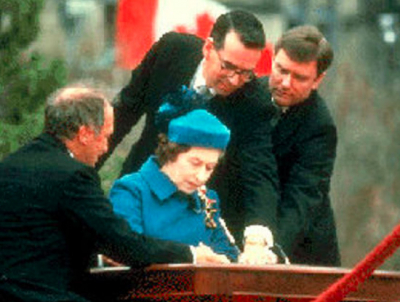
Queen Elizabeth signing Proclamation of Constitution Act, 17 April 1982
17 April 1982
There is no definitive moment in history that marks the birth of Canada as an independent nation. Instead, we have a series of dates representing steps along a constitutional continuum from colonial subordination to complete independence. To complicate matters further, Canada became effectively independent decades before the legal papers were signed. Confusingly, none of the dates coincide with Canada Day on 1 July. Canada Day commemorates the passage of the British North America Act (BNA Act), a piece of British legislation that took effect on that date in 1867, giving birth to the Dominion of Canada. The Act, which set out religious and linguistic rights as well as the respective responsibilities of the federal and provincial governments, became Canada’s constitution. One thing it did not do was change Canada’s status within the British Empire.
Notwithstanding the fuzziness over when Canada became independent, there are two strong contenders for a Canadian “independence day.” The first is 11 December 1931, when the Statute of Westminster received Royal Assent in London. The second is 17 April 1982, when Queen Elizabeth assented to the Constitution Act 1982 in Ottawa. While the former date has its merits, I favour the latter.
When the Statute of Westminster became law on 11 December 1931, the British Parliament renounced its right to enact laws for a dominion without the consent of the dominion government, or to overturn dominion legislation that was considered “repugnant” to English law under the Colonial Validity Act of 1865. The Statute was the culmination of work undertaken by Canadian Prime Minister Mackenzie King, in concert with other dominion leaders, especially South Africa’s J.B.M. Hertzog, at the Imperial Conference of 1926. Leaders agreed that the United Kingdom and dominion governments (Canada, Australia, Union of South Africa, New Zealand, Newfoundland, and the Irish Free State) within the British Empire were in no way subordinate to each other in both domestic and foreign affairs, though all were united through a common allegiance to the Crown, and were freely associated members of the British Commonwealth of Nations.
Up until the Statute’s passage, Canada’s governors general were appointed by the British government (or more correctly by the Crown on the advice of the British government) and reported to British authorities. After 11 December 1931, Canada’s governors general were appointed by the Crown on the advice of the Canadian government. As well, diplomatic contacts between the Canadian and British governments were handled by high commissioners who held ambassadorial rank rather than by governors general talking to their British authorities. Canada could also conduct its foreign affairs with other countries without British involvement, though it had already been doing so for some years by convention, signing a bilateral agreement with the United States as early as 1911.
However, whether the Statute of Westminster implied independence is debatable. In 1959, Maurice Allard, the Progressive Conservative MP for Sherbrooke, was sufficiently convinced that he submitted a private member’s bill in the House of Commons to declare 11 December Canada’s Independence Day. Like most private members’ bills, however, his proposal went nowhere.
Back in 1931, the Statute’s passage was largely ignored; there were no independence-day fireworks. The Ottawa Evening Citizen’s brief coverage was sandwiched between a story on an abducted American co-ed and another on four Christmas turkeys left at an Ottawa police station. Toronto’s Globe covered the Statute on page fourteen. While calling it “an admirable piece of legislation,” the newspaper stated, “But let us be honest, who in Canada, barring a few gentlemen suffering from ‘status’ on the brain, worries about the Statute of Westminster?” In another article, the Globe wrote “As far as Canada is concerned, everything remains virtually as it was before the constitutional hair splitting commenced. Canada has governed herself without any interference from any outside source since 1867; She will continue to do so.”
The Globe was partially right. The last time Britain overturned a Canadian law was in 1873 with respect to an act dealing with oaths. But while Canada was effectively independent when it came to domestic matters, it remained subordinate in foreign affairs. Consequently, when Britain declared war on Germany in August 1914, Canada was automatically committed on Britain’s side. Things were different following the passage of the Statute of Westminster. Britain’s declaration of war on Germany in September 1939 did not mean Canada was at war. To stress Canadian independence, Prime Minister Mackenzie King waited a week before joining the Allies. While Canada and Britain had the same monarch, the Crown had effectively been divided. There was now a British Crown and a Canadian Crown, with the same person wearing both “hats.” The divisibility of the Crown subsequently became a generally-accepted constitutional principle throughout the Commonwealth, with the Queen speaking on the advice of her Canadian prime minister when she is in Canada, and on the advice of her Australian prime minister when she is in Australia, etc.
Notwithstanding the Statute of Westminster, legal and constitutional links with Britain remained after 1931 which continued to place Canada in a subordinate position. The Judicial Committee of the Privy Council in London was Canada’s highest appellant Court until 1949 for civil cases. Canada’s Governors General continued to be Britons for another twenty years; the first Canadian appointed to the post, Vincent Massey, didn’t take office until 1952. Most importantly, the Statute explicitly exempted changes to the BNA Act from its purview. In other words, Canadians were unable to make changes to their own constitution without the consent of the British Parliament. This was not a task the British government had insisted on retaining. Rather, the anomalous situation was due to the inability of the federal and provincial governments to agree on a formula to make constitutional amendments. Consequently, Canada’s Parliament remained subordinate to the British Parliament in one vestigial but important way until the BNA Act was finally patriated in early 1982 by the government of Pierre Trudeau.
On 29 March 1982, Queen Elizabeth, wearing her “hat” as Queen of the United Kingdom, assented to the Canada Act 1982, legislation passed by her British Parliament at the request of the Canadian government to patriate the BNA Act to Canada. Three weeks later, on 17 April 1982, as Queen of Canada, she assented in Ottawa to the Constitution Act 1982, legislation passed by her Canadian Parliament. This Act, which includes Canada’s Charter of Rights and Freedoms, and a constitutional amending formula, forms part of Canada’s Constitution. Other key parts of the Constitution include the BNA Act, renamed in Canada as the Constitution Act 1867, and subsequent amendments.
The decision to patriate the Constitution was highly controversial. Two years earlier, with the failure of a separatist referendum in Quebec on “sovereignty association,” Prime Minister Trudeau had promised constitutional renewal to Quebec. But despite lengthy negotiations, a federal-provincial consensus could not be reached. A major sticking point was the proposed charter of rights and freedoms which many provinces feared would transfer powers from legislatures to the courts. Only Ontario and New Brunswick supported Trudeau. The others, known as the Gang of Eight, which included Quebec, held out. Following last ditch talks in Ottawa in November 1981, and threats by Trudeau to patriate the Constitution without provincial support, a position that the Supreme Court ruled as being legal though not desirable, the Gang of Eight collapsed. In what later became known as the “Night of Long Knives,” a late-night agreement was reached in Ottawa among the leaders of the federal government and nine provinces after Levesque had left the negotiations to go to bed. In his memoirs, Levesque said that “he had been stabbed in the back by a bunch of carpetbaggers.”
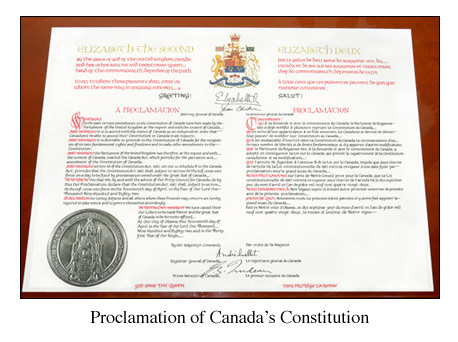 17 April 1982 was a drab, rainy day in Ottawa when Queen Elizabeth appended her signature to the Constitution Act on an outdoor dais setup on Parliament Hill. The proclamation document was also signed by Prime Minister Trudeau, André Ouellet, in his capacity as the Registrar-General, and Justice Minister Jean Chrétien. 32,000 spectators watched the historic occasion, undaunted by torrential rain showers. People started to show up on the Hill as early as 5.30am, five hours before the scheduled event. But the event was clouded by more than just the weather. Quebec, under the separatist Parti Quebecois government of René Levesque, boycotted the event. Instead, Levesque led a demonstration in Montreal against the new Constitution attended by 20,000 people. With considerable hyperbole, the demonstrators called Quebec’s Liberal MPs who supported the new Constitution “traitors,” and the Constitution, a “charter of genocide.”
Trudeau made reference to Quebec’s absence at the patriation ceremony on Parliament Hill. Speaking to the “silent majority” in Quebec, he remarked that the Charter and the amending formula which allows Quebec to opt out of any constitutional change that might touch on language and culture with full financial compensation, did not sacrifice anything “essential to the originality of Quebec.” For her part, Queen Elizabeth, speaking in French, expressed sorrow for Quebec’s refusal to participate in the proclamation of Canada’s new Constitution. She ended her remarks saying “Today, I have proclaimed the new Constitution – one that is truly Canadian at last. There could be no better moment for me, as Queen of Canada, to declare again my unbounded confidence in the future of this wonderful country.”
In the years that followed, attempts were made by the federal government under Brian Mulroney to find a formula acceptable to Quebec. With the failure of both the Meech Lake and Charlottetown Accords in the late 1980s and early 1990s, the constitutional issue was put on the back burner, the nation fatigued by its constitutional problems. The Province of Quebec has still not endorsed the Constitution Act.
Sources:
CBC, 2001, “The Knight of Long Knives,”.
Edinger, Elizabeth, 2011-12. Casebook, Law 100, Canadian Constitutional Law, University of British Columbia, http://faculty.law.ubc.ca.
Department of Justice, 2013. The Constitution Acts 1867 to 1982.
Heard, Andrew, 1990. Canadian Independence.
Hilmer, Norman, 2013. “Patriation: The Constitution Comes Home,” Historica Canada.
Senate of Canada, 2014. The Constitution Table, Royal Proclamation on Parliament Hill.
The Globe, 1931. “Constitutional Safeguards,” 9 April.
———————, 1931. “Score for the First Week,” 16 November.
———————, 1931. “Westminster Bill Goes to Committee in British House,” 21 November.
———————, 1931. “Finis to Status,” 5 December.
——————–, 1931. “Westminster Bill Given Final Assent,” 11 December.
The Ottawa Citizen, 1982. “The nation’s coming of age was a day made for children,” 19 April.
———————-, 1982. “Queen offers Quebec praise for its cultural contribution,” 19 April.
———————-, 1982. “Ceremonies leave PM in a Whirl,” 19 April.
———————-, 1982. “PQ renews drive for separation,” 19 April.
———————-, 1982. “Queen Elizabeth: ‘I have seen a vision of this country take shape,’” 19 April.
———————-, 1982. “PM: Constitution a fresh beginning,” 19 April.
The Ottawa Evening Citizen, 1931. “Westminster Statute Given Royal Assent,” 11 December.
The National Archives (UK), 2014. Statute of Westminster 1931.
Images: Queen Elizabeth signing Proclamation of Constitution Act, 17 April 1982.
Proclamation of Constitution Act, Government of Canada.
Story written by James Powell, the author of the blog Today in Ottawa's History.
Retired from the Bank of Canada, James is the author or co-author of three books dealing with some aspect of Canadian history. These comprise: A History of the Canadian Dollar, 2005, Bank of Canada, The Bank of Canada of James Elliott Coyne: Challenges, Confrontation and Change,” 2009, Queen’s University Press, and with Jill Moxley, Faking It! A History of Counterfeiting in Canada, 2013, General Store Publishing House, Renfrew, Ontario. James is a Director of The Historical Society of Ottawa.